Showing posts with label Buddhism Basics. Show all posts

Wednesday, January 2, 2019

I AM TWO PEOPLE


I am two people.  Not of a parallel universe, nor a radical personality disorder; but a person with a strong Physic background and a practicing No Bullshit Buddhist. 
 

Physics describes the world around us with concrete laws backed up by provable experimentation and mathematics equations.    Theoretical Physics strives to explain why things are as they are, and the logical consequences of expanding known attributes into the unknown.   Astrophysics attempts to explain the universe; the beginning, the now and  the future of the cosmos.


Buddhism says it’s all bullshit – it doesn’t matter – the NOW is all we have: how we live this day, in each moment, in total awareness can bring us peace and tranquility throughout this short life – and that’s really all that matters.


Steve Hagen, a trained Physicist, now a Buddhist priest explores the links between Science, Philosophy and Perception in his book HOW THE WORLD CAN BE THE WAY IT IS.
  

Steve Hagen is the reason I practice my own version of Buddhism today.
 

My first interest in Buddhism came after reading THE THREE PILLARS OF ZEN by Roshi Philip Kapleau in the 1960’s.   Afterwards I read numerous books with esoteric explanations of Buddhism, many verging on religion and mysticism.  It wasn’t until Steve Hagen’s BUDDHISM PLAIN AND SIMPLE that I was able to codify a simple (No Bullshit) Buddhist practice that seemed practical and worthwhile to me.


I am still awed by Theoretical Physics; but, especially at my age, it is strictly entertainment.   Zen is a way of life. 

   
I have fallen away from my ZEN practice, but now it is time for me to come back.

The beginning of this new year is a good time to explore ZEN as a more peaceful and conscious way to live.
  

If you are interested, I recommend starting with Buddhism Plain and Simple.   I will also post a series of earlier blog post I have done over the years.   My particular Buddhist practice is personal, and I feel each person should develop their own – or not.  There are Buddhist Sangha in almost every state for more formal Buddhist training. 
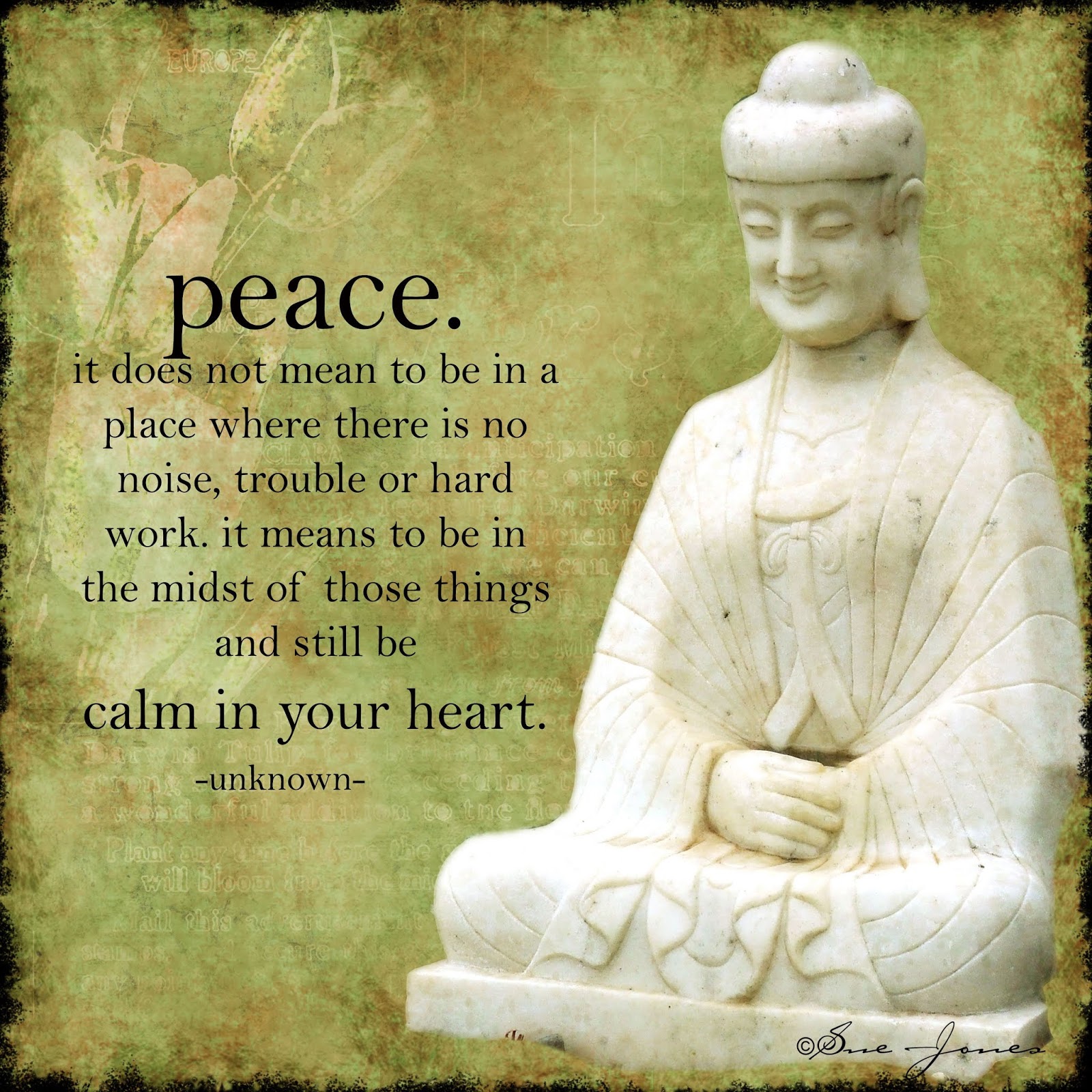


And, of course, you don’t need Buddhism or religions to live a good life and be a good person. 


the Ol’Buzzard   

Thursday, September 3, 2015

ZEN: DRAGGING THE BOAT


Two young men left their village to attend a talk by the Buddha.   It was to be a three day journey so the men left a day early to insure they would arrive in plenty of time to enjoy the preceding. 

 After two days they arrived at a river only to find the bridge had been destroyed.  Knowing they had an extra day they set about constructing a boat from bamboo and reeds.   The next morning they made the crossing and were feeling confident as they still had a day for travel.
 
The oldest man said that it was such a fine boat it would be a shame to leave it, so they each grabbed a gunnel and started down the road.
   
The men arrived in village just as the Buddha finished talking.   They approached the Buddha and told him how disappointed they were to have missed his talk.   The Buddha look at the men and the boat and asked why they dragging a boat.  The men said they had built it to cross the river and that it was such a fine boat they could not leave it.  
The Buddha smiled and walked away.

I sit here in my den/office/man-cave or whatever you want to call this room that all the artifacts of decades of my life are jumbled into and look around at the boat that I have been dragging: books on sky diving (not going to happen,) books on white water canoeing ( I no longer own a canoe,) survival gear, hunting and fishing gear, pictures and artifacts hanging on the walls, three boxes of cassette tapes ( I no longer own a cassette player,) Sherlock Holmes collections and the list could go on.

I have been dragging most of this stuff around with me for decades – some for over fifty years.  

I tend to think of this stuff as defining me; but in truth I was a different person at each time this stuff represents.   However, they bring back pleasant memories.

You can’t stand in the same river twice.

I guess we all drag our boats, and perhaps that is only a bad thing when it prevents us from living in the present or obstructs our future goals.

Hell I don’t know
Just rambling
the Ol’Buzzard


Monday, August 31, 2015

MOREZEN


Buddhism is more than meditating.


Here in the west we hold ideas of how things ought to be and how we ought to live.  We are constantly at war with our environment trying to make everything fit into our desired outcome – and when we fall short, which we most often do, we carry the stress of failed expectations.

We hold a fixed idea of who we are and how we want to be perceived.   But there is no fixed I or Ego because everything changes – new causes produce new effects. 

One and the same human being is, at various ages, under various circumstances, a totally different human being.
Solzhenitsyn:  The Gulag Archipelago

The Buddha realized that most often people were carrying stress, and that this stress prevented them from appreciating the refreshing taste of cool water – the beauty of a young girl – or the satisfying taste of rice (his awakening.)   

Buddha also realized that the stress is most often self-inflicted.   He addressed this in The Four Noble Truths.

The Four Noble Truths

1.     Duhkha*: Life is often like a wheel out of kilter. We are constantly dissatisfied.    We feel we have to fight for control.   We move from one crisis to the next – reacting – never satisfied with our outcome. 
2.     Our dissatisfaction originates from our own expectations and desires.
3.     By focusing on, and being content in the present, instead of fantasizing on future or the past, we can alleviate much of our dissatisfaction.  
4.    The Eight Fold Path is the Buddha’s teaching – a suggested path toward a fulfilling and contented life.
   
*(Spelled Duhkha in Buddhism Plain and Simple; spelled Dukha in The Essence of Zen; spelled Dukkha in Intro to Buddha – and probably other spellings.   There are four major sects of Buddhism: Theravada, Mahayana, Vajrayana and Zen; this probably creates confusions in spellings and definitions.  It is the concept that is important.)

THE EIGHT FOLD PATH

1.    RIGHT VIEW:  accepting the way your world is, though not necessarily the way you would like it to be.  Understanding that nothing is static and everything is changing. 
2.    RIGHT INTENTION: address each problem in your life with resolve; but always choosing the noble path – you instinctively know what is right and what is wrong: for the good of all – unselfish centered.
3.      RIGHT SPEECH: speak the truth; but never to injure.
4.     RIGHT ACTION: act from a clear mind, not from preconceptions or prejudices.  
5.     RIGHT LIVELYHOOD: we should strive to choose an occupation that benefits others, and one that satisfies our needs; but we should apply ourselves in whatever endeavor we occupy.
6.    RIGHT EFFORT: live in the NOW.
7.    RIGHT MINDFULNESS: conscious of how we are actually engaged in the world from moment to moment.
8.    RIGHT MEDITATION: practice zazen regularly

Notice that the Buddha does not give commandments – there is no ‘thou shall not…’   These are the Buddha’s suggestions – his clarity.

Buddhism is not a belief system.  It is not about accepting beliefs or following rituals.   It is about seeing the world clearly.  

It is said that at his death the Buddha told his followers ‘Look not for refuge to anyone beside yourself.’    


the Ol’Buzzard

Saturday, August 29, 2015

MEDITATION IS THE VEHICLE OF ZEN


Meditation is the vehicle of Zen.


When I attended a Zen teaching I realized that meditation was not being practiced as a refreshing reset of the mind but an endurance sport.  My legs went to sleep, my butt ached and my back hurt.  It was a grand effort to keep my mind empty while my body was expected to remain in a stress position.   After what seemed an eternity we hobbled up and did walking meditation around the room and then back to the torture.  

It is said that during Japanese Zen meditation in monasteries Zen masters walk around with bamboo canes and whip the backs of neophytes that are flagging in their meditation zeal.

I can’t believe that this is what the Buddha expected.  

The Buddha’s awakening was that cold water from a well was delightful and refreshing; that a young girl was beautiful and that simple rice tasted delicious.

After searching for the meaning of life the Buddha realized that the meaning had always been surrounding him, but he had been too distracted to see.   Being alive is being in the moment and the ability to put aside distraction and enjoy the Now. 

Meditation helps us to control distractive thoughts and to focus the mind.   There are monkeys in our minds and they swing from tree to tree and constantly chatter.   Through meditation we can learn to calm the monkeys and take control of our own thoughts.

Joan Sutherland said it best in This Floating World: “Awakening is not a destination and meditation is not a bus ride.”

Meditation is simply a tool to empty your mind and relax your body – to empty your thought process so that subsequently you can focus on the present without distractions from the past, or the future or fantasies of how you would like things to be. 

Zen meditation is known as Zazen.

Zazen aims to develop the individual’s power of concentration.

  1. Find a quiet pleasant place to meditate.
  2. Provide a cushion or pillow to raise your butt allowing you to comfortably cross your legs in front of you.
  3. I place one hand in the other in my lap with thumbs touching (I find that after practicing this a while it becomes an automatic indicator to the mind that it is time for meditation.)
  4. I prefer to close my eyes at the beginning and begin focusing on my breathing while consciously relaxing my body, but at the same time keeping an upright posture.
  5. Some people count their breaths but I find that distracting; I prefer to visualize the air going into my lungs and then expelling.  I visualize this process over and over while slowing down the breaths as the body relaxes.  
  6. The monkeys will try to run through your mind and distract you with random thoughts.  When this happens you don’t give them pride of place, but refocus on your breath. 
  7. You might start with five minutes; but stop if you become uncomfortable – you can increase time with practice
  8. When you are done, sit for a few moments and continue to regulate your breathing while you look around – come out peacefully.

“A thought rises.  A thought last awhile. A thought goes away.   What a relief it is when every passing thought or reaction doesn’t automatically take pride of place, doesn’t need us to bend the world according to its whim”     Joan Sutherland

I can have my blood pressure taken, then place my hands together with thumbs touching and clear my mind and have the blood pressure taken again, and it will have dropped at least ten points.

Meditation works in the moment to calm you; but with constant practice it helps your ability to stay focused on the activity and surrounding of each moment. 

The beauty of life, the meaning of life is happening in the present moment if you can only take the time to see it. 


the Ol’Buzzard  

Wednesday, August 26, 2015

BACK TO ZEN


BACK TO ZEN
TRY AGAIN
LIVE IN MINDFULNESS

How many times I have come back
The crazy world
Distracting
Unsettling
I find myself wandering in a forest of anxiety
Dashing about in frustration
Seeing no way out
Never noticing the path I am standing on
And the beauty of the trees around me.  

This morning I got up, did some stretches, weights, and then meditated for five minutes.
  
I have fallen away from the beauty and contentment of the path less traveled, and become lost among the masses that trod the well-worn road that inevitably leads to anxiety and discontent ((Duhkha.)

I am over the hump of my seventies and seem to be aimless.   I am reacting instead of acting; I am focusing on things I have no ability to change; the stream of the world is flowing by around my ankles and I am stomping at the waves; I have lost my mindfulness – and it is time to return…  to Zen.

It is not a distant journey; it is only one step.
As I move back to mindfulness, I will post the journey.  

Zen reminds us that if we don’t see the beauty and mystery of our present life – our present moment; it is unlikely we will live in the beauty of any moment of life.


NOW is holy

the Ol’Buzzard

Wednesday, February 12, 2014

THE LAST NAKED BUDDHISM POST


After the previous post that addressed the conscious effort necessary to understand the problems and the causes of confusion and stress in our life; and after realizing how simple meditation is preformed; the final step in Naked Buddhism is living a productive life through the Buddha’s teachings. 


Whether or not the actual Buddha prescribed the Eightfold Path is inconsequential.    Like the Bible, the Buddha’s teachings were past from oral tradition through hundreds of translations.   I would like to think that the Buddha suggested these guidelines for living a fulfilled life, but regardless of the origin they seem to me a path worthy to strive and to follow. 


The eight aspects of the path, also known as the Eightfold Path, are: right view, right intention, right speech, right action, right livelihood, right effort, right mindfulness and right meditation.  

Note - in other religions restrictions are laid down: though shall not…   In Buddha’s teachings the Buddha simply insisted that you inherently know what is right and wrong, and that you always choose the right over the wrong action.   Instead of laying down laws the Buddha described a path that can help in leading a fulfilled life on this earth.  


Grumpy cat - a true Naked Buddhist - accepts nothing on faith.
1.    RIGHT VIEW:   The Buddha recognized that the world is in a state of constant change – constant flux - and to hold a rigid view or concept or belief or opinion is to become entrenched in dogma.   We should clear our mind of preconceptions and view the world and situations as they actually are in the moment.  Accept change and adjust accordingly.

2.    RIGHT INTENTION:   Interact with the world selflessly – for the good of all – not self centered.   Begin each day with compassion for others and a realistic understanding of what the outcome of our actions will have on others. 

3.    RIGHT SPEECH:   Speak the truth as you perceive it, but never speak to injure others. 

4.    RIGHT ACTION:   Following charismatic leaders and becoming entrenched in doctrines and dogma is relinquishing you free thought and will.   Be your own person - do what you know to be right.

5.    RIGHT LIVELYHOOD:  The ideal job would be one that we would enjoy.  This is what we all wish for; but in reality few are so fortunate.   In our material world we work at jobs strictly in order to live a lifestyle that we desire.  We have to meet the basic requirements of food, shelter and security; and of course it is our nature – and not bad - to want more; provided that an obsession to succeed doesn’t distract us from living each day to the fullest.      It is also important that we not knowingly work in any occupation that causes harm to others.   Therefore, because we must work, we should try and be conscious, productive and satisfied with our labor,   Change the things we can change and except the things we can not.

6.    RIGHT EFFORT:   We should make an effort to live in each moment.   We should also realize that the things we do effect others and we should endeavor to cause no harm.  Living in the NOW requires we step away from our preconceptions, prejudices and social conformities and address each issue anew – making decisions as needed; all the time striving to appreciate the beauty and  wonder of the moment – being aware of the privilege of being alive. 

7.    RIGHT MINDFULNESS:  We should seek to be conscious in each moment.  We should be aware of the distractions that seem to demand our attention and realize that it is the NOW that is important.   We should consider how we are actually engaged in the world from moment to moment and recognize that unconscious stress (duhkha) is the cause of discontent - and only by identifying the cause can we except the problem and move beyond it.

8.    RIGHT MEDITATION:  Right meditation is making meditation an integral part of our daily life.   We should take time each day to meditate – if only for a few minutes.  Through meditation we clear our minds of distractions and become focused.   By meditating we relax our body and give our mind down time – a rest period – a reboot. 


There is much more to Buddhism: Buddhist stories, sayings, concepts and art.  But the naked basic teaching of the Buddha is to live productively in the moment – fully aware each day – and to appreciate the beauty and mystery of our short life.   All the rest is distraction.  


the Ol’Buzzard