Thursday, April 21, 2011

MY PERSONAL BUDDHISM

MY FINAL COMMENTS ON BUDDHISM
(About as close to religion as I can come.)


I have been a practicing Buddhist since the 1970’s when I first read The Three Pillars of Zen by Roshi Philip Kapleau.  I have studied under a number of teachers (books) since then; my favorite is Steve Hagen’s Buddhism Plain and Simple.

As you might have noticed, my Buddhist beliefs do not align with any particular Buddhist sect; and this, I think, is probably as the Buddha would have intended. Most Buddhist sects will insist that the only way to be a Buddhist (to find enlightenment) is to have a teacher, meditate, practice the Darms (Buddhist teachings) and belong to a Sangha (Buddhist community/ church.)
  
Buddhism and the Sangha  

I have read, in many Buddhist magazines, that enlightenment is only possible through the trinity of meditation, the Darma and the Sangha.   This, of course, has been promulgated by teachers who are, or were involved in Sanghis; and who also state “you must trust your teacher.” 

I visited my first Sangha a few months ago.   I experienced all the robes and the gongs and the ceremony.  Everyone seemed to be focused on who could endure the most discomfort by sitting the longest in meditation  – who could count the highest before the squirrel ran through their mind (attention deficit), and who could honestly avow that it was all being done for nothing – with no expectation but to emulate the Buddha.

It was unstated that if you must ask why am I doing this?   The answer was - there is no reason – and if you had to ask you didn't get it.

I have no problem with people who feel they benefit by guidance from direct transmission, and for those whom the religious overtones of the Sangha make a connection.  I do, however, take exception with the idea there is only one way. 

I could make the analogy that all the members at the Possum Lodge (the Red Green Show) must play dead whenever they hear a loud noise in order to immolate the passivity of the possum (Quando Omni Flunkus Moritati - when all else fails play dead.)  And why would you want to do that?  If you have to ask you obviously haven’t obtained the possum truth. 
   
I believe the Buddha’s message was that you do not need Gods, or religions (Sanghas,) or ceremonies; you do not even need the Buddha (What should we do if we meet the Buddha?...Kill him.) .

 He taught that each person has the ability of the Buddha. What part, if any, of his story is true is not important – his life is an analogy of teaching.   You pass through here for a short time – a mere point in the space time continuum. You can not control your life – yesterday and tomorrow are illusions – you can only try to live fully and consciously in the NOW before it’s gone. 

The Buddha sent his teachers out, not to form churches as the necessary path to enlightenment, but to inform the masses that their quality of life, regardless of their situation, could be improved if they would release their stress and live in the moment – that they must accept the things they can not change and change things that need changing, and learn to be satisfied with their lot. 

How marvelous,
How Wonderful:
I chop wood,
I carry water.

Before enlightenment,
I chop wood,
I carry water.

After enlightenment,
I chop wood
I carry water.


Buddha gave us the Four Noble Truths to explain that there is no happily ever after, and that the monkey that constantly runs through our mind is a major reason that out life wheel is out of kilter; that in order to bring our life back into balance we must be able to accept our hardships and focus our minds in order to cage the monkey.  

This is where I take exception to the idea that there is no objective to be desired from meditation.   In meditation there is no one blinding instant that we suddenly realize we are brighter then we were thirty seconds before.  However, it is only through the practice of meditation that we can discipline our mine; and, only by disciplining our mind can we cage the monkey that is a major cause of distraction to living in the NOW.    We can only achieve and maintain mindfulness through the continued practice of meditation.


After presenting us with this realization, the Buddha offered us the Eight Fold Path as his suggestion for living a wholesome life of fulfillment. 

The Buddha stressed that we should believe no one – not even himself.   That we should accept no doctrine on faith; follow no guiding principles, except those that we personally find valid.   


MORE: 

Alas poor Yorick, I knew him well.
After a near death experience I came as near to enlightenment as possible.   There was a dawning that I was alive in the moment.  Everything that I saw, felt, tasted and experienced was magnified and grandiose: colors appeared more vivid, smells were exotic and the feel of rain, or snow or cold on my body was exhilarating. 

Unfortunately this last for a month or six weeks, or three months at the most, but gradually my life morphs back into the distracted existence where concerns, worries, prejudices and other distractions send me blindly through an existence of reaction and consequence.  It takes a conscious effort through attention and meditation to remain conscious of how wonderful and fragile life is.


Buddha sought the meaning of life by experiencing religious dogmas and seeking learned teachers.   He performed strict regiments of austerity and self discipline rejecting all pleasures of life while seeking some magical moment where he could experience an awakening beyond the mere conditions of human existence.  But when he was near death and at his lowest ebb, he perceived the beauty of a young girl; the wonderful taste of rice and the refreshment of cool water.   This was his awakening.   The meaning of life is – that for the moment we exist – and during this moment life is wonderful if we will only pay attention, and NOW IS ENOUGH.   Beyond this there is no meaning of life.  


Monday, April 11, 2011

Buddhism Simplified

A BRIEF OVERVIEW OF BIDDHIST PHYLOSOPHY


The analogy of what our life can be is a wheel spinning in perfect balance. When we randomly add weights to the circumference of the wheel (desires, concerns, dogma, pain, obsessions) then the wheel begins to run out of kilter. Our life becomes  tense and our health suffers; our relationships suffer. We are not happy – we do not feel fulfilled.


There are no Thou Shall and Thou Shall Not’s in Buddhist philosophy. The Buddha made no threat of hell and no promise of life after death. We must remember that the Buddhist texts (like the Bible) were not written until five hundred years after his death; and were written for a religious Asian population, who considered an ox drawn cart to be cutting technology. When you distill down to the very basics of the philosophy you will find that the Buddha only recommended a path to a fulfilled life in the present. This path is as valid today as it was in his lifetime.


The very basis of Buddhism is the Four Noble Truths. This is where the Buddha addresses the root causes of a discontented life.


The 4 Noble Truths

1. Our lives are often out of balance because of self-induced stress.

2. Stress arises from our own dissatisfaction: from unquenchable desires, from our resistance to change and from the realization of our own mortality.

3. When we are capable of realizing the origin of our dissatisfaction we can bring our life back into balance

4. We may not be able to end our problems, but we can end our dissatisfaction and embark on a wholesome lifestyle by following the Eight Fold Path.


The Eight Fold Path is not an edict but a formula for wholesome living.

The Eight Fold Path
1. Right View: Focus on the NOW without concern for the past or the future. Look at the world as it really exists. Put aside all beliefs, dogmas and expectations of others. Rely on logic and your own judgment. Accept only what you see as real.

2. Right Intentions: Consciously move toward a life of enlightenment (contentment in the NOW) and insure your actions hurt no one. Realize that material objects are impermanent and should not become of major important in your life. Never allow a dissatisfaction to become an obsession. Accept the circumstances you cannot change and change the things that you are capable of changing

3. Right Speech: Speak the truth, but never speak to injure.

4. Right Actions: Apply yourself totally to the present moment. Focus only on the endeavor at hand. Harm no one. Act in harmony with the environment and with all sentient beings.

5. Right Livelihood: Seek a profession that is fulfilling and causes no harm.

6. Right Effort: Meditate. Keep your mind clear of distractions. Accept your present condition. Free yourself of dogma and religious and political cant. Show compassion for all living things. Work diligently.

7. Right Mindfulness: Cherish this moment. Recognize and put aside all prejudice. Accept that pain is sometimes a natural part of living. Be aware of the impermanents of all things.

8. Right Meditation: When random thoughts obstruct your focus on the NOW you are experiencing a monkey mind. The practice of meditation can discipline you mind and sharpen you focus. Zazen is my meditation of choice.

Can Buddhist practice solve all your problems?


A ZEN story:


A farmer approaches the Buddha who is sitting by the roadside.
Farmer: “Oh great teacher I have come to you for advice.
Buddha: “What is your need?”
Farmer: “I have many troubles. My farm is rocky and the ground is hard; I can barely raise enough to feed my family. When I am away my wife is with other men. My children do not respect me and my dog hates me. We have had too little rain this year and I have lost my rice crop; and, on top of all of this I am growing sore and stiff with age. Tell me great teacher, what can I do to be rid of my troubles?
Buddha: “Nothing.”
Farmer: “Nothing? What kind of advice is that?
Buddha: “We all have 67 troubles. If you solve one on the top another will take its place on the bottom. You will still have 67 troubles.


Yet, another ZEN story:

A man joins a monastery known to be very strict. The monks in this monastery are allowed to speak only two words every ten years. After ten years the monk comes before the abbot. “What have you got to say?” says the abbot. “Bed hard,” says the monk. Ten years later the monk again comes before the abbot. “What have you to say?” ask the abbot. “Food stinks,” replies the monk. Ten years late the monk again meets with the abbot. “What have you to say?” ask the abbot. “I quit!” replies the monk. “Well, I’m not surprised,” replies the abbot. “All you ever do is complain.”


You put your right foot out
You put your right foot in
You put your right foot out
And you shake it all about.
You do the Hokey Pokey
And you turn yourself around.
That’s what it’s all about.

The next blog will recap and bring to closure Buddhism as a lifestyle. 

Thursday, March 31, 2011

BUDDHISM: Life in Prespective


WHEN YOU MEET THE BUDDHA - KILL HIM.

We face the woeful prospect that we are intelligent creatures living in a meaningless world.
Buddhism Plain and Simple.
By Steve Hagen:


As you might have guessed I do not believe in gods, angles, ghost, fairies, gnomes, devils, demons, spirits, sprites, life after death and things that go bump in the night. Just because I can not explain my existence does not logically imply a supernatural causation; and likewise, my rejection of religious mysticism does not imply immorality. Many people claim that morality exist because of religion – I would say it exist despite religion. (See my blog entry RELIGION: Oct 10, 2010)

In my estimation, the person who came closest to getting it right was the Buddha. Basically, his philosophy was that yesterday is an illusion and tomorrow doesn’t exist. We only have this present moment to live in; and, if we do not perceive the beauty and worth of this moment then we are squandering our life.

Stories of the Buddha, like the stories in the Bible, are greatly exaggerated. For twenty five hundred years people have had the opportunity to add to, subtract from, reinvent and reshape the Buddhist legend to their own liking and purpose. The basic story, however, whether factual or an analogy, is the basis of a poignant philosophy. (Check web link below)

Introduction to Buddhism


BUDDHA THE ANALOGY
A young man from a wealthy family is depressed by the realization that death is inevitable. He leaves his family and seeks solace from religion. After seeking and following many different teachers he still feels discontent and misery. His questions are not answered. Finally he becomes an ascetic. After years of meditating for many hours each day and denying himself food and water and even shelter from the elements, his health deteriorates. As a last effort he decides he will sit by a tree in a park and meditate until he either reaches enlightenment (understanding why he must eventually die) - or he will to die under that tree. While he is meditating a beautiful young girl comes to the park to draw water. She sees the young man, emaciated and sickly. She brings him cold water to drink. The water is invigorating. She offers him a bowl of rice and the rice taste wonderful. He marvels at the beauty and grace of the young girl, and at the beauty all around him. He realizes at this moment that life is not about how long you live or what happens after you die, but about living in the beauty of each minute of each day. (Check web link below)

The Story of Buddha

The Buddha’s teaching can be expressed in a number of ways: Stop and smell the flowers; It’s the little things in life that count; Live in the moment; or as Buddhist teachers like to say, WAKE UP!

It is ironic that the Buddha taught a simple philosophy, not a religion. Yet, everywhere Buddhism spread the people felt the need to turn the Buddha’s teachings into a religion. Bells and whistles and robes and stories and riddles and ceremonies were all added to satisfy a need for religious mysticism.

Of all the Buddhist sects, I perceive ZEN to be the truest path to Buddha enlightenment. The only real goal of ZEN is to discipline you mine in order to be able to give yourself over totally to whatever you are doing in the moment. Beliefs, points of view, religious dogma, and an obsession with evil, death and life after death only obscure the reality of the present. Unfortunately many ZEN sects focus on meditation as a goal in itself, rather than of the tool to enlightenment.

Here in the west, we are a material society. We live from want to want. If only we could obtain that car, or that sex partner, or that house, or that job we would be happy. Of course, we will never be content, for there will always be another illusive object needed for our fulfillment. Meanwhile, life passes through us. We find ourselves fearing death and unable to face the total termination of our own existence. Religions find it easy to proselytize us with a promise of life after death.

The dog dies, the cat dies, the rabbit dies, the horse dies, the frog dies, the fish dies, you die, the fly dies, the cockroach dies, the tree dies, the rose bush dies, the Pope dies, the microbe dies, the chicken dies, the hamster dies, eventually the sun dies and life on earth is dead – and that’s all. Get over it.


In the next blog I will list the basic principles of Buddhist practice - without smoke and mirrors - for western understanding.   
Links listed above:
http://abcnews.go.com/US/video/boy-buddha-10239921

http://video.pbs.org/video/1461557530/

Friday, March 25, 2011

YOU ARE GETTING OLDER - GET USE TO IT.


LIFE DEATH AND THE HOKEY POKEY.


What is it like to grow old? You know, it may seem funny, but I don’t know. I am in my seventies, but I don’t think of myself as an old man. I look in the mirror and I see the grey hair and beard, the old man’s tits, the wrinkles on my face and spots on my hands. I know I get out of breath when I exert myself, I don’t have endurance and my balance isn’t so great; but, I don’t think of myself as old. In my mind I feel exactly like I did when I was thirty-five I am still sexual, I like new adventures, I like an element of danger – the adrenalin rush, I still feel like an alpha male; I’m a thirty-five year old with age disabilities.


The main difference is - I am aware I don’t have a future. I can’t plan ahead… I can’t say, “In a few years I will travel someplace, or I’ll get another degree and a new occupation field, or perhaps in five or ten years I will …” I don’t even buy Craftsman tools for my tool box – because you buy Craftsman tools for the long haul. This is it. This is what I have. Today is the rest of my life. I still feel like I can fight, fuck, play contact sports or run a footrace – but that damn common sense tells me I am not the man I was. Age is a disability I have to learn to live with.


I know I am smarter than I use to be. I no longer do stupid things to impress young women. I tend to view the world more holistically and less egotistically. I am better educated and have more mistakes to reflect on.


I also find I am plagued with sometime annoying short term memory retention. When I’m cooking I will walk to the refrigerator and think, “What the hell did I come over here for.” I occasionally can’t remember if I took my blood pressure pill in the morning and will have to check the pill box. But, this doesn’t bother me. I look at the brain as a hard drive with finite memory capacity. I have been downloading information to my hard drive for seventy years and I have reached a saturation point, so if I add something new, something else is automatically deleted and my computer is running slow.  Think of the things in my hard drive: early childhood memories, twelve years of public school, twenty-two years in the military, world travel, two degrees, three occupations; the list can go on and on and on – experiences – memories – adventures - people I have known. My hard drive is full.


So here I am, with the realization that I am near the end; and I have to ask myself: is the Hokey Pokey really what it is all about?

My next blog will discuss the concepts of Buddhism; which is my formula for accepting the condition of aging.   Through Buddhism mindfulness I am able to bring quality and enrichment to each day.

Sunday, March 13, 2011

NORTH TO ALASKA


ARCTIC MEMORIES

 The Arctic in his soul
Like a chill from Arctic cold
Holds memories of Arctic places
And dark hair Arctic faces
That haunt his dreams and memories
Now that he’s grown old


How do you explain a place
That’s lost in time and space
Where the sun begins to set
Though it hasn’t risen yet
And the brief light of merging days
Creates a dreamlike eerie pace


Where snow you know is white
Drabs grey in Arctic light
And spruce that should be green
Define black the Arctic scene
A skeletal world of dark and light
That spawns apparitions in Arctic twilight.


Where the wind on dark nights moan
Driving chills down through you bones
And the northern lights aglow
Reflect unearthly on the snow
The frozen scene where reality bends
And visions haunt you when alone.

And the Arctic in his soul
Like a chill from Arctic cold
Holds memories of Arctic places
And dark hair Arctic faces
That no one wants to hear
Now that he’s grown old.


My wife and I taught school in the remote Indian and Eskimo villages of bush Alaska for eleven years. In the Arctic we would get up in the dark, go to school in the dark, come home in the dark and go to bed in the dark. We lived as invaders in a third world culture and were sometimes looked on with disdain.

Writing Poetry (of sorts) became an outlet for me.
I plan to share some Poems over the lifetime of this Blog.


In 1985 my wife and I graduated from college and immediately headed to Alaska for teaching jobs.  We made the trip of almost 6ooo miles in ten days.  


Shortly after arrival we were hired to teach in an Athabascan Indian village about 130 miles north of Fairbanks. 


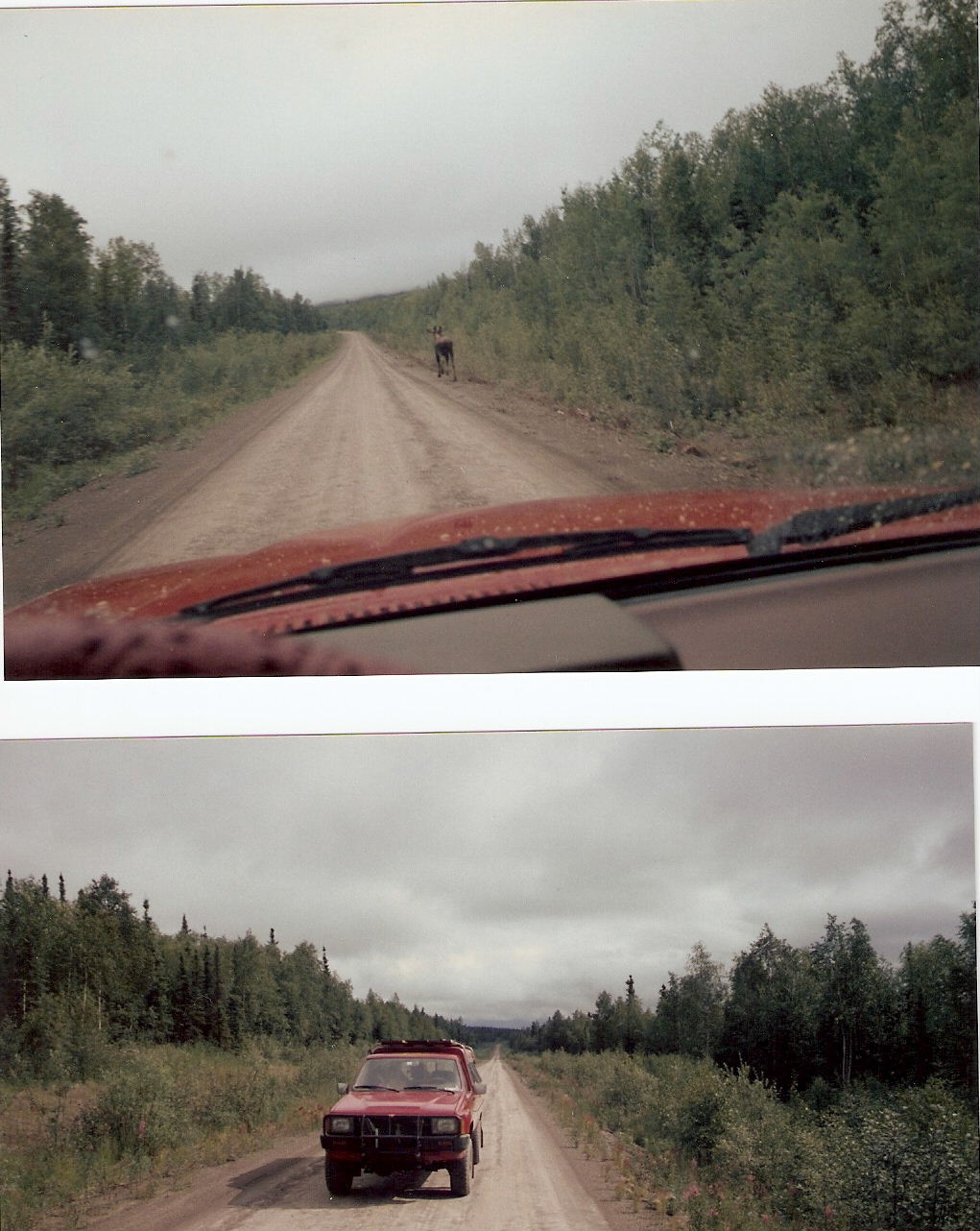
The village was on the road system, though the trip was arduous.   The road was kept open most of the year, but especially in the winter the trip could be a dangerous so we only make the trek out three or four times a year.


Haul Road

road to the village

The village was one hundred and thirty miles north of Fairbanks: seventy-five miles up the gravel “Haul Road” to Prudhoe Bay and then fifty-five miles on a one lane dirt road into the village. The trip to Fairbanks took between four and five hours when the roads were passable. We would usually travel to Fairbanks on food or medical runs and occasionally on school holidays to touch base with our own culture.  


WINTER TRAVEL

The road gets long going into Fairbanks,

As November winds swirl and howl and blow up drifts;

And darkness settles in early at the Pass.

The road to the village at fifty below zero.


When we arrived in the village for our first teaching job the village Chief came over to indoctrinate us. Among other things he said that the village had two wells we could draw water from. One was at the generator shed but it was polluted so we should use the one at the lodge (community building.) A few weeks later he came and told us that the well at the lodge was polluted so we should use the one at the generator shed. A few weeks later he came and told us the one at the generator shed was polluted so we should use the one at the lodge – this continued in some form for the rest of the year (We went into Fairbanks and bought a water distiller.)

The next year the state put in a new well at the fuel farm – and guess what… they struck fuel oil in the water.

Snow melt water
The third year the government paid for a new well but it was placed in a low swampy are and in the spring time the swamp flooded and polluted the well.

When we came in for our fifth year a new well had been drilled but half way through the winter the well went dry. We melted snow for bathing and dishes, and on the weekends traveled to the nearest village at the end of the road, fifty miles further down, to do our wash and bring back water.


THE WELL DILEMMA

It’s winter in Alaska

And it’s forty below.

The wind it’s howling

And it is starting to snow


One new well’s polluted

Another’s run dry.

The one drilled this winter

Doesn’t work – don’t ask why.


Five wells in five years

And you’re still afraid to drink.

For the water looks like coffee

And has a god-awful stink.


Winter road to the nearest village
to wash clothes and get drinking water.


So come this weekend

We’ll risk winter slaughter.

Driving a hundred miles

For ten lousy gallons of water

They also had a Road House
we could get a hamburger and beer
Our village was dry.

Death is not an unusual occurrence in the village. People die from old age, from fights over women and from alcohol and drug related incidences.  Many of the villages are only accessible by air and air crashes are fairly common.  


The Stick Dance to communicate with the dead.

In 1990 a young principal in our school district in an arctic village died in a plane crash.  He was married to a native and had three young girls and an infant son.  He was traveling with his girls into Fairbanks when the bush plane crashed on takeoff.  He was thrown clear but went back into the burning plane for his daughters.  His wife and infant son were not traveling with them. 


A good man dies an agonizing death
Only after finding his children dead

The woman who yesterday had a family, laughing, talking, dancing
Today is all alone-

The past wiped out in one unbelievable moment.

There is no god that would allow this.

In 1990 we had been teaching in the same village for five years (most teachers only last two or three years in the bush.) We liked teaching Native children and felt we were good at it. Our gold was to remain bush teachers until we could vest in a retirement and truly retire.


DAY DREAM 1990

I would like to see a time
When I can sit with pen and rhyme
No obligations to a job
No firm commitment time to rob
With days to do as I should please
To walk the woods and smell the breeze
And sit beside a roaring fire
And gloat because I am retired.


We stayed in Alaska for eight years.  When we left we moved around, did some travel and finally returned to Maine.   In 2004 we returned to Alaska for three years where I was principal in two southwestern villages.  More on that at sometime in the future. 


A link to a web page for Alaska teachers and visitors:   Alaska Web Sights


Wednesday, March 9, 2011

WARNING - R-RATED

I recently saw a bumper sticker in a grocery store parking lot that read “WORKING MEN VOTE REPUBLICAN.” I felt that there should have been a second sticker explaining the first - that would either read: “BECAUSE I MAKE OVER TWO HUNDRED AND FIFTY THOUSAND DOLLARS A YEAR” or, “BECAUSE I AM A MORON”.


The Republicans took the House in the last election with a promise to create jobs. Since they have been in power the only thing they have done is pass tax cuts that favor the wealthy, try to kill the health care bill, propose ideological cuts to discretionary spending and attempt to legislate restrictive abortions laws against women.

The abortion issue is Republicans hypocrisy. They love a fetus. From conception to birth is holy for Republicans; but after a child is born they don’t give a damn.

Some of the cuts the Republican Congress are pushing for are to defund prenatal care, cuts to wellness programs and cuts to WIC (Women Infants and Children) which provides Federal grants to States for supplemental foods, health care referrals, and nutrition education for low-income pregnant, breastfeeding, and non-breastfeeding postpartum women, and to infants and children up to age five who are found to be at nutritional risk.

They wish to cut Food Stamps; Aid to Dependent Children; Head Start; the school milk program and the school lunch and breakfast programs. They plan to repeal the Health Care Law; to cut student aide for college.

They can’t wait until the child is old enough to go into the military and be sent into unnecessary wars. They celebrate the dead and wounded soldiers while at the same time proposing cuts to VA Hospital funding.

If you are out of work – tough: they would like to do away with the minimum wage, unions and unemployment benefits. They plan to cut Medicaid, Medicare and Social Security. They do, of course, want to remove estate taxes so if you are mega-wealthy you can pass along your estate, tax free.

Republicans pretend that tax cuts don’t affect the national debt. They tell you that tax cuts are not the same as spending. In reality taxes are income. A tax cut reduces the nation’s income. A three percent tax cut for me amounts to about two hundred and fifty dollars – a three percent tax cut for a billionaire is another yacht.

Republicans openly support huge expensive tax breaks for the wealthiest one-percent of the nation and giant subsidies for Mega-Oil Companies which increases the national debt by decreasing revenue. They are fine with placing the burden on the working middle-class.

Working Men Vote Republican…….Why?