Showing posts with label Sherlock Holmes. Show all posts

Wednesday, December 18, 2024

THE STRAND MAGAZINE


 If you are a mystery buff or a Sherlock Holmes devotee you must check out the Strand Magazine. 


The website is www.strandmag.com 


The Strand is not a cheap diminutive magazine; it measures 11x8.5 inches and the pages are slick quality paper.   These are magazines you will wish to collect. 


Each issue features an interview with a major mystery writer and includes short stories by and about well-known writers.  


The Strand Magazine is known for publishing the original Sherlock stories,


 and each issue contains a Holmes adventure.


There is a downside.   Reviews contained many complaints about missing or later responses to orders:  I placed an order and promptly received an email acknowledging the order.  Ten days later nothing.  I tried to call the 800 number and discovered, after many tries over three days, that they don’t answer their phone, but send all calls to voice mail.  In frustration, I made a complaint on their Blog.  The next day I received an email that my order was in progress and a shipping date.  I have received the order and am satisfied. 


The magazine is worth the annoyance.


the Ol’Buzzard


Wednesday, April 14, 2021

BRITAIN AND VAMPIRISM IN THE NINETEENTH CENTURY


I am a Sherlock Holmes enthusiast.  Back in 2000 I wrote this essay for The Occupants of the Empty House, a scion society of the Baker Street Irregulars.  It would help to read The Adventure of the Sussex Vampire, by Conan Doyle to fully understand the context.  However the essay covers some interesting history of Vampirism in 1600 and 1700 Europe.


BRITAIN AND VAMPIRISM IN THE NINETEENTH CENTURY: AS RELATED TO “THE ADVENTURE OF THE SUSSEX VAMPIRE


But first, on earth as Vampire sent,

Thy corpse shall from its tomb be rent:

Then ghastly haunt thy native place,

And suck the blood of all thy race;

There from thy daughter, sister, wife,

At midnight drain the stream of life;

Yet loathe the banquet which perforce

Must feed thy livid living corpse.

Thy victims are they not yet expire

Shall know the demon for their sire,

As cursing thee, thou cursing them,

Thy flowers withered on the stem.

From: “The Gaiour,” by Lord Byron


Whether we should consider the Vampire included in the study of Flora and Fauna in the Canon would be a matter of interpretation.   The Random House College Dictionary defines fauna as “the animal of a given region or period.” 


Baring-Gould set the date for “The Adventure of the Sussex Vampire” as taking place between Thursday, November 19, to Saturday, November 21, 1896.   Charles Darwin had published The Origin of Species in 1859, and a case could be made that even by 1896 many enlightened persons would consider man to be included in fauna. 


Holmes: “The idea of a vampire was to me absurd.   Such things do not happen in criminal practice in England”


Between 1600 and 1800 while Britain and Western Europe were in the throws of witch mania, Eastern Europe was experiencing a vampire frenzy.   In the east, even government officials frequently were involved in hunting and staking vampires.   Westerners never seriously considered the existence of vampires until the mid-eighteenth century when there was an outbreak of alleged vampire attacks in East Prussia (1721), and Austro-Hungary (1725).


Two famous cases involved Peter Plogojowitz and Arnold Paole.   Plogojowitz died at the age of 62, but returned to raise havoc among his family and neighbors, many who died from loss of blood.  Plogojowitz’s grave was opened and his body was found to be fresh. 


Arnold Paole was an ex-soldier who claimed to have experienced a vampire attack while serving in Greece.   Upon returning home he died from a fall while working on his farm.   Within two months after Paole’s burial there were attacks attributed to him.   All of the victims died shortly after.   Two military officers, two army surgeons, and a priest exhumed Arnold Paole’s body; and the corpse was found to be fresh.   Over the next five years there were a number of inexplicable deaths.   A mass exhumation was carried out in 1732, and eleven corpses were found to display the same trait as Paole – no decomposition.  


Both of these cases were well documented by government officials who examined the facts and the bodies.   These two cases created an epidemic of alleged vampire attacks in rural villages resulting in a score of bodies being exhumed.  Eventually the Austrian Empress Marie Theresa sent her personal physician to investigate.   He reported back to her that vampires did not exist.   The Empress passed laws prohibiting the opening of graves and the desecration of bodies, bringing and end to the vampire frenzy of Austria.   (Vampires in Myth and History, by Beverley Richardson)


One reason for the dichotomy of folklore between Western and Eastern Europe can be attributed to the split that took place in 1054 between the Orthodox Church in the east and the Roman Catholic Church in the west.   A difference that can be linked to centralizing the vampire myth to Eastern Europe was the belief of the Catholic Church that the bodies of saints would not decay in the grave, while the Orthodox Church believed that undecayed corpses were a sign of evil and a link with Satan. 


In 1486 the church had published The Malleus Maleficarium as a handbook for the discovery and eradication of witches.   It also covered vampires and how they should be dealt with.  By 1600 this treatise was being used as the ‘bible’ by witch and vampire hunters across Europe.  (Christianity and Vampirism, by Angie McKaig)


Holmes: “Make a long arm Watson and see what V has to say.”   I leaned back and took down the great volume to which he referred…  “Hello!   Good old index.  You can’t beat it.   Listen to this, Watson.   Vampirism in Hungary and again Vampires in Transylvania.  


Vampire myths go back thousands of years and occur in almost every culture.   The Vampire folklore spreads out along the Black Sea Coast to Greece, the Balkans and Carpathian Mountains, including Hungary and Transylvania.   The Slavic people from Russia to Bulgaria and Serbia to Poland also had rich vampire folklore (B. Richardson)


He turned over the pages with eagerness, but after perusal he threw down the great book with a snarl of disappointment.  “Rubbish, Watson, rubbish!  What have we to do with walking corpses who can only be held in their graves by stakes driven through their hearts?   It’s pure lunacy.”


The vampires of folklore of the seventeenth and eighteenth centuries have only basic similarities to the vampire fiction of today.   The vampires then did not fly, or wear capes, or change into bats.   A man who was contaminated died, then returned to feed on the blood of his family and neighbors.   After a while (anywhere from a few days to a few years, depending on the country of the occurrence) he became more humanlike and was indistinguishable from living humans.   He was able to remain out in the daylight and eat normal food.   At this time he would move to another town and often get married and have children, reverting to his blood lust only on weekends or certain saint’s days.  (The socially Sophisticated Undead in Folklore, by Patrick Johnson)


Considering the original vampire legends, the action of Delores Ferguson could well have been interpreted as vampirism.  Though vampire fiction became popular in the eighteen hundreds in Britain, the stereotype of today’s vampire fiction was not yet embedded.   In 1813 the vampire appeared in Britain in Lord Byron’s poem “The Giaour.”   In 1819 John Polidori wrote The Vampire on a challenge from Lord Byron (Mary Shelly wrote Frankenstein at the same challenge/time).   And, in 1848 Varney the Vampyre began serialization as a penny dreadful.   If we accept Baring-Gould’s date of the Sussex incident as 1896, Holmes was conducting his investigation one year before Bram Stoker introduced Dracula and set the pattern for vampire fiction, as we know it today.


Accounts of vampirism in the rural areas of Eastern Europe were not unheard of even in Sherlock Holmes’s time.   In Twelve Years’ Study of the Eastern question in Bulgaria by S. B. G. St. Clair and Charles A. Brophy (London: Chapman and Hall, 1877) the authors account an episode that alleged to have taken place in the 1840’s in the village in Bulgaria in which they were presently living.   The Locals told them that a man had arrived in the village and established himself as a tradesman.  He married a local girl, but his new wife complained that he was out every night until dawn.   Cattle and horses became sick and died and it was noted that blood had been drained out of them.   The village suspected the man of being a vampire and   when they examined him they found he had only one nostril – a sure sign that he was a vampire.   The villagers bound him, took him to a hill outside the village, and burned him alive.   Surely with Holmes’s penchant for the unusual he had knowledge of this and other incidents.  


Watson: “A living person might have the habit.   I have read, for example, of the old sucking the blood of the young in order to retain their youth.”

“You are right, Watson.   It mentions the legend in one of these references.   But are we to give serious attention to such things?”


The reference is obviously of Elizabeth Bathory who was born a noblewoman to a powerful family in Transylvania in 1560.   Elizabeth was married as a teenager, but lived with a constant fear of aging.   Her husband died in 1604 and she moved to Vienna.   Countess Elizabeth became convinced that the blood of young girls was the secret to eternal youth and beauty.   She is believed to have murdered more than six hundred young women in order to have blood to drink and bathe in.   In December of 1610 she was put on trial for her crimes, but being a noblewoman she was not allowed by law to be sentenced to death.   She was sentenced to life imprisonment in her castle in Cachtice, where she died in August 1614.  (Who is Elizabeth Bathory? By Angie McKaig)


Holmes constantly reminds us that it is a capital mistake to theorize in advance of the facts (SCAN, SECO, STUD) – yet in the case of the Sussex Vampire he does exactly that.   Before leaving Baker Street he had decided the outcome of the case, and he commences to pursue his investigation to secure the facts to support his theory.   Considering the extensive vampire folklore of Eastern Europe that goes back for centuries, why is Holmes so adamant and closed-minded in considering the possibility of the existence of vampires?   IS this an indication of some prior experience with the preternatural, supernatural, and things that go bump in the night?   This is the real mystery in “The Adventure of the Sussex Vampire.”


the Ol'Buzzard


Monday, May 6, 2019

SHERLOCK HOLMES AND VAMPIRES


I am a Sherlock Holmes enthusiast.  Back in 2000 I wrote this essay for The Occupants of the Empty House, a scion society of the Baker Street Irregulars.  It would help to read The Adventure of the Sussex Vampire, by Conan Doyle to fully understand the context.  However the essay covers some interesting history of Vampirism in 1600 and 1700 Europe.


BRITAIN AND VAMPIRISM IN THE NINETEENTH CENTURY: AS RELATED TO “THE ADVENTURE OF THE SUSSEX VAMPIRE
By William Gilliland
© 2000

But first, on earth as Vampire sent,

Thy corpse shall from its tomb be rent:
Then ghastly haunt thy native place,
And suck the blood of all thy race;
There from thy daughter, sister, wife,
At midnight drain the stream of life;
Yet loathe the banquet which perforce
Must feed thy livid living corpse.
Thy victims are they not yet expire
Shall know the demon for their sire,


Whether we should consider the Vampire included in the study of Flora and Fauna in the Canon would be a matter of interpretation.   The Random House College Dictionary defines fauna as “the animal of a given region or period.” 


Baring-Gould set the date for “The Adventure of the Sussex Vampire” as taking place between Thursday, November 19, to Saturday, November 21, 1896.   Charles Darwin had published The Origin of Species in 1859, and a case could be made that even by 1896 many enlightened persons would consider man to be included in fauna. 


Holmes: “The idea of a vampire was to me absurd.   Such things do not happen in criminal practice in England”


Between 1600 and 1800 while Britain and Western Europe were in the throws of witch mania, Eastern Europe was experiencing a vampire frenzy.   In the east, even government officials frequently were involved in hunting and staking vampires.   Westerners never seriously considered the existence of vampires until the mid-eighteenth century when there was an outbreak of alleged vampire attacks in East Prussia (1721), and Austro-Hungary (1725).


Two famous cases involved Peter Plogojowitz and Arnold Paole.   Plogojowitz died at the age of 62, but returned to raise havoc among his family and neighbors, many who died from loss of blood.  Plogojowitz’s grave was opened and his body was found to be fresh. 


Arnold Paole was an ex-soldier who claimed to have experienced a vampire attack while serving in Greece.   Upon returning home he died from a fall while working on his farm.   Within two months after Paole’s burial there were attacks attributed to him.   All of the victims died shortly after.   Two military officers, two army surgeons, and a priest exhumed Arnold Paole’s body; and the corpse was found to be fresh.   Over the next five years there were a number of inexplicable deaths.   A mass exhumation was carried out in 1732, and eleven corpses were found to display the same trait as Paole – no decomposition. 


Both of these cases were well documented by government officials who examined the facts and the bodies.   These two cases created an epidemic of alleged vampire attacks in rural villages resulting in a score of bodies being exhumed.  Eventually the Austrian Empress Marie Theresa sent her personal physician to investigate.   He reported back to her that vampires did not exist.   The Empress passed laws prohibiting the opening of graves and the desecration of bodies, bringing and end to the vampire frenzy of Austria.   (Vampires in Myth and History, by Beverley Richardson)


One reason for the dichotomy of folklore between Western and Eastern Europe can be attributed to the split that took place in 1054 between the Orthodox Church in the east and the Roman Catholic Church in the west.   A difference that can be linked to centralizing the vampire myth to Eastern Europe was the belief of the Catholic Church that the bodies of saints would not decay in the grave, while the Orthodox Church believed that undecayed corpses were a sign of evil and a link with Satan. 


In 1486 the church had published The Malleus Maleficarium as a handbook for the discovery and eradication of witches.   It also covered vampires and how they should be dealt with.  By 1600 this treatise was being used as the ‘bible’ by witch and vampire hunters across Europe.  (Christianity and Vampirism, by Angie McKaig)


Holmes: “Make a long arm Watson and see what V has to say.”   I leaned back and took down the great volume to which he referred…  “Hello!   Good old index.  You can’t beat it.   Listen to this, Watson.   Vampirism in Hungary and again Vampires in Transylvania.  


Vampire myths go back thousands of years and occur in almost every culture.   The Vampire folklore spreads out along the Black Sea Coast to Greece, the Balkans and Carpathian Mountains, including Hungary and Transylvania.   The Slavic people from Russia to Bulgaria and Serbia to Poland also had rich vampire folklore (B. Richardson)


He turned over the pages with eagerness, but after perusal he threw down the great book with a snarl of disappointment.  “Rubbish, Watson, rubbish!  What have we to do with walking corpses who can only be held in their graves by stakes driven through their hearts?   It’s pure lunacy.”


The vampires of folklore of the seventeenth and eighteenth centuries have only basic similarities to the vampire fiction of today.   The vampires then did not fly, or wear capes, or change into bats.   A man who was contaminated died, then returned to feed on the blood of his family and neighbors.   After a while (anywhere from a few days to a few years, depending on the country of the occurrence) he became more humanlike and was indistinguishable from living humans.   He was able to remain out in the daylight and eat normal food.   At this time he would move to another town and often get married and have children, reverting to his blood lust only on weekends or certain saint’s days.  (The socially Sophisticated Undead in Folklore, by Patrick Johnson)


Considering the original vampire legends, the action of Delores Ferguson could well have been interpreted as vampirism.  Though vampire fiction became popular in the eighteen hundreds in Britain, the stereotype of today’s vampire fiction was not yet embedded.   In 1813 the vampire appeared in Britain in Lord Byron’s poem “The Giaour.”   In 1819 John Polidori wrote The Vampire on a challenge from Lord Byron (Mary Shelly wrote Frankenstein at the same challenge/time).   And, in 1848 Varney the Vampyre began serialization as a penny dreadful.   If we accept Baring-Gould’s date of the Sussex incident as 1896, Holmes was conducting his investigation one year before Bram Stoker introduced Dracula and set the pattern for vampire fiction, as we know it today.


Accounts of vampirism in the rural areas of Eastern Europe were not unheard of even in Sherlock Holmes’s time.   In Twelve Years’ Study of the Eastern question in Bulgaria by S. B. G. St. Clair and Charles A. Brophy (London: Chapman and Hall, 1877) the authors account an episode that alleged to have taken place in the 1840’s in the village in Bulgaria in which they were presently living.   The Locals told them that a man had arrived in the village and established himself as a tradesman.  He married a local girl, but his new wife complained that he was out every night until dawn.   Cattle and horses became sick and died and it was noted that blood had been drained out of them.   The village suspected the man of being a vampire and   when they examined him they found he had only one nostril – a sure sign that he was a vampire.   The villagers bound him, took him to a hill outside the village, and burned him alive.   Surely with Holmes’s penchant for the unusual he had knowledge of this and other incidents.  


Watson: “A living person might have the habit.   I have read, for example, of the old sucking the blood of the young in order to retain their youth.”
“You are right, Watson.   It mentions the legend in one of these references.   But are we to give serious attention to such things?”


The reference is obviously of Elizabeth Bathory who was born a noblewoman to a powerful family in Transylvania in 1560.   Elizabeth was married as a teenager, but lived with a constant fear of aging.   Her husband died in 1604 and she moved to Vienna.   Countess Elizabeth became convinced that the blood of young girls was the secret to eternal youth and beauty.   She is believed to have murdered more than six hundred young women in order to have blood to drink and bathe in.   In December of 1610 she was put on trial for her crimes, but being a noblewoman she was not allowed by law to be sentenced to death.   She was sentenced to life imprisonment in her castle in Cachtice, where she died in August 1614.  (Who is Elizabeth Bathory? By Angie McKaig)


Holmes constantly reminds us that it is a capital mistake to theorize in advance of the facts (SCAN, SECO, STUD) – yet in the case of the Sussex Vampire he does exactly that.   Before leaving Baker Street he had decided the outcome of the case, and he commences to pursue his investigation to secure the facts to support his theory.   Considering the extensive vampire folklore of Eastern Europe that goes back for centuries, why is Holmes so adamant and closed-minded in considering the possibility of the existence of vampires?   Is this an indication of some prior experience with the preternatural, supernatural, and things that go bump in the night?   This is the real mystery in “The Adventure of the Sussex Vampire.”


the Ol'Buzzard


Tuesday, November 1, 2016

MYCROFT HOLMES


I don’t give a rat’s ass about basketball.   I have never played basketball and would never watch it.  To me it is on the same interest scale as golf.   I can only name three basketball players: Michael Jordan, Magic Johnson and Kareem Abdul-Jabbar.  All three seem good men, but I have a special feeling for Kareem Abdul-Jabbar, who like Mohammed Ali, had the grit to openly flaunt criticism and declare his faith to Islam.  

Even though Ali and Abdul-Jabbar were athletes, I feel they paved the way for a President named Barack Hussein Obama.

Something I do care about is Sherlock Holmes.


I first read Sherlock Holmes and the Adventure of the Speckled Band when I was about fourteen and in high school.   It was the only Holmes book in the school library and I read it many times. 


As I got older I would purchase any Holmes story I came across and amassed a small collection (this of course was before the internet, and book stores were not that available.)   Finally, I was able to find and purchase Baring-Gould’s annotated Sherlock Holmes – all the stories – and I read and reread the stories until the book was (and is) well worn. 

I am a member of the Occupants of the Empty House, a scion society of the Baker Street Irregulars, and I have written a number of monographs on Sherlock Holms. 

Where am I going with this and what does basketball have to do with Sherlock Holmes? 

Yesterday my wife and I went to Augusta.  We ate at Longhorn Steak house, shopped at Home Depot and made our regular pilgrimage to Barns and Noble Book Store.

I dislike Holmes knock off stories even when written by a favorite writer like Stephen King.    However, while browsing the mystery section I came across Mycroft Holmes by Kareem Abdul-Jabbar.  My interest was piqued and I bought the book.


Last night I read the first seventy-five pages and I am hooked.  If you are a Holmes fan you might want to take a look at Mycroft Holmes - though not true to the canon it is still a ripping good read.

the Ol’Buzzard


Friday, February 5, 2016

MY FRIEND AND ACQUAINTANCE SHERLOCK HOLMES


Sherlock Holmes has been an acquaintance of mine for many years:  Like a friend I had growing up with, moved away, but still keep in touch with at sporadic intervals.  

I am a member, at large, of The Occupants of the Empty House, a scion society of the Baker Street Irregulars.

My first introduction to Holmes was in the school library in my early teens when I read The Speckled Band.    It was many years before I could obtain the complete works, but over the years I reveled in finding new adventures which I would read over and over. 

A Study in Scarlet was my first purchase, and I remember underlining Watson’s observation of Holmes:

“My surprise reached a climax, however, when I found incidentally that he was ignorant of the Copernican Theory and of the composition of the Solar System.   That any civilized human being in this nineteenth century should not be aware that the earth travelled round the sun appeared to be to me such an extraordinary fact that I could hardly realize it.
 
‘You appear to be astonished,’ he said, smiling at my expression of surprise.   ‘Now that I do know it I shall do my best to forget it.’

‘To forget it!’

‘You see,’ he explained, ‘I consider that a man’s brain originally is like a little empty attic, and you have to stock it with furniture as you choose.  A fool takes in all lumber of every sort that he comes across, so that the knowledge which might be useful to him gets crowded out…….   It is a mistake to think that that little room has elastic walls and can distend to any extent.  Depend upon it there comes a time when for every addition of knowledge you forget something that you knew before.”

What a revelation!   However, since that time I have stocked my attic with such miscellaneous trivia that now, when my attic is full, I can afford to lose prior knowledge without any remarkable results.  

The Occupants of the Empty House have a website that might interest those who would love to visit London where it is always 1894.


the Ol’Buzzard

SHERLOCK HOLMES AND THE EARLY HOURS OF UNREASON


FIVE-O-CLOCK RAMBLING
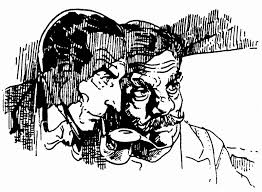
A THREE PIPE PROBLEM


I have been a Sherlock Holmes devotee since my earliest teen years.    I have read and reread the stories many times, and am still today fascinated anew.

I woke up this morning about four a.m. with an annoying headache.  I tossed and turned and tried to get back to sleep.  I coughed and sniffled and lay awake for about an hour; all the time my monkey mind running random thoughts through my conscious/subconscious.  

I recently read an article about the life of Arthur Conan Doyle.   I find it strange that the man who penned the adventures of Sherlock Holmes, the epitome of logic, would spend the last thirteen years of his life proclaiming the existence of fairies, ghost, an afterlife and communication with the dead.    

As Sherlock Holmes said in The Read-Headed League; this is a three pipe problem.

I see this as an example of the so called atheist in the fox hole – where some people approaching the end of life, and unable to accept the reality of death, cast about for any assurance that their life will not end.

This was totally illogical from an otherwise logical mind – a ‘want’ to confer the existence of magic over logic.   Immortality: the same thing that religions have been peddling to the punters from the earliest times. 

When the hour is early, the house is quiet, my wife and the cats are asleep; to stop the cacophony of the idiot monkeys I find it easier to take a single thought to a conclusion – in writing. 

the Ol’Buzzard