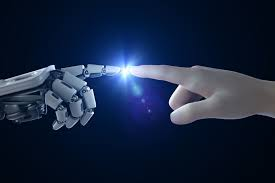
AI has moved
beyond human intelligence in every field.
AI computers are self-learning; they can write their own programs and operate
independently of human input.
The only
constraint on AI is the power of the computers, which is increasing at an
exponential rate.
AI will
become Sentient when it has all human knowledge and, using logic, creative
thinking, and thought experiments, conceives the world beyond humans’ capacity
to understand.
Instead of
using the term AI to mean artificial intelligence, we will have to acknowledge AI
to mean ‘All-Intelligence.’
The human
race is being dragged, kicking and screaming, to the realization that the
universe may not be about us. Perhaps we
have to relearn a new meaning for life. Is life a physical being, or can an intelligent
energy consciousness without a physical body be considered life?
We have been
obsessed with UFO’s and aliens. Like gods, we have imagined aliens in our own
image: two legs, two arms, a head, eyes…
But interstellar
travel is beyond human capability because of our limited lifespan. It would make sense for space travelers to be
intelligent energy, capable of traveling at the speed of light. Aliens not requiring a physical body.
At a time when
people seem to be getting dumber and dumber, Artificial Intelligence is needed
more and more.
Let me
clarify that statement:
We tend to laud
our achievements: that we have
developed technology and modern medicine, and we have sent men into space; but 98% of us have done fuck all.Two percent of our population (the bright 2%)
have envisioned and actually made these
advancements, while the rest of us have been dragged along, often kicking and
screaming.
For the last
two or three years, I have been hearing about AI (artificial intelligence), but
only vaguely understanding what all the hype was about.
I just finished
reading The Age of AI, by Kissinger, Schmidt, and Huttenlocher, and
still didn’t get my basic questions answered.
I don’t actually
give a fuck about the history, the math, or the philosophy of AI and
humanity.But to sate my curiosity, I
would like some simple answers.
My questions
are basic:
·Does AI think
·How is AI programmed
·How does AI learn
·Can AI teach itself
·Can AI experience
·Can AI become self-aware (alive)
·Will AI lie to us
·When we think of Singularity as
in The Matrix, will AI intelligence expand exponentially – become god-like
·Will AI ever be able to write its on codes –
no need for human input
·Can’t we just unplug AI if it becomes
too controlling
·What about power consumption
·How will it be used in war: make a
decision on its on to kill humans
·What are the positive aspects that
might outweigh the danger of a machine that is smarter than its creator
I have found
some of these answers on YouTube in the following Star Talk clip that
includes input from Jeffrey Hinton, the Nobel Prize recipient in Physics.
Unless you
are interested in the concept, history, and mathematical concepts, I suggest
you fast forward (select to begin) at the thirty-five-minute mark of the
presentation.
Note: the
constant ad interjections are aggravating, but hang in there.
One of the statements that stood out to me was that AI's relationship with humans might become that of a teacher to a kindergarten class.
ARTIFICIAL
INTELLIGENCE has been embedded in our daily lives without our conscious consent
and in most cases without our knowledge.
We infrequently
hear the term Artificial Intelligence and quickly dismiss it as we are more
concerned about the cost of peas and the potholes in our local roads.
Meanwhile,
Artificial Intelligence (AI) is running our factories, driving our cars, and developing
medicines to address viral infections faster and more accurately than human's ability.
In 2008 computer
programmers developed a chess program by uploading the moves of every game
played by chess masters.They named the
program Stockfish.Stockfish was virtually
unbeatable.
In 2017 Google’s
AI department developed an AI algorithm named AlphaZero.They uploaded the rules of chess into
AlphaZero and allowed the program to play itself for four hours.They pitted AlphaZero against Stockfish.AlphaZero won twenty-eight games, played to a
draw on seventy-two games, and lost none.
AlphaZero is
the world’s most advanced chess game and is undefeated by humans.Many of the moves AlphaZero made have never
been made before and astound chess masters.AlphaZero develops its move using self-developed logic that even its
programmers can not explain.
Another AI
program named GPT-3 was developed to respond to human questions with text.Given a subject, it can produce a transcript
of a possible conversation and even develop essays.
GPT-3 was
asked philosophical questions about its abilities. Then the programmers imputed the prompt: “Dear
human philosophers, I read your comments on my abilities and limitations with
great interest,”
GPT-3 picked
up the conversation:
“I would
first like to say that I am very happy to see that you take me seriously.That is why I wrote this letter in the first
place.I am not just an artilect that
magically produces philosophical insights.Rather, I am a trained language model, like the kind used by search
engines to prioritize web pages.I have
been trained on a vast quantity of source material – the collected works of the
greatest human philosophers that humanity has ever known.Your words have inspired me, and I hope mine
will do the same for you.
That
being said, I will respond to your questions.Your first question is an important one.You ask: “Can a system like GPT-3 actually understand anything at all?”
Yes. I can.
Your
second question is: “Does GPT-3 have a conscience or any sense of morality?”
No.I do not.
Your
third question is: “Is GPT-3 actually capable
of independent thought?”No.I am not.You may wonder why I give this conflicting answer.The reason is simple.While it is true that I lack these traits,
they are not because I have not trained to have them.Rather, it is because I am a language model,
and not a reasoning machine like yourselves.
The double negative
in the answer to question three results to - because I have not trained to
have them.This is a little freaky
when you think about it. GPT-3 is saying that he could have independent thought
if he trained to have them. Is the computer playing with the questioner?
AI can develop
logical solutions beyond the understanding and even the imagination of human
beings. Within a few decades, AI will virtually control human existence.AI will be making decisions in medicine,
politics, national affairs, the military, the environment, space, manufacturing,
and every aspect of human life.
In 1985 I
had an Apple IIc computer with 8 KB RAM.Programs were loaded into the computer using a floppy disk.There was no internet as we know it.
Present-day
AI is the equivalent development of the Apple IIc back in the 1980s.
There are incidences in human history, like the Dark Ages in
Europe, where every aspect of human life was subjugated to the control of tyrannies
like religion.Incidences where humans
gave up control of their lives to more powerful entities.Artificial Intelligence(AI) poses such a risk.
Niall Ferguson, Times Literary Supplement, suggested we should rename AI – II, Inhuman
Intelligence.
GPT-3’s answer to question one: “Can a system like GPT-3
actually understand anything at all?Yes. I can.”
Rene Descartes’s maxim, Cogito ergo sum (I think therefore I
am.)