We can declare
ourselves an intelligent species only because there is no other species to
dispute us.
Exceptional savants produce art and music and
architecture that we consider evidence of higher-level thinking skills. Our scientists
have taken us into new frontiers, and we are living in a world of advanced technology, as compared to only fifty tears ago.
But then we
can tune into a Trump rally, or see white supremacist marching with
tiki-torches, or the glazed look of people attending televangelist mega-churches
and we must conclude that, on the whole, we are a pretty mediocre species and
prone to the highest level of gullibility.
Without any proof
or logical analyses, people choose to believe in gods and angles and devils and
heaven and hell and ghost and vampires and werewolves and fairies and sprites and witches and shapeshifters and alien abductions ….
There are
those who have historically taken advantage of our gullibility. P.T. Barnum said ‘There’s a sucker born every
minute.’ He also said, you can never
make a mistake by underestimating the intelligence of the human race.
The human
race is not special.We are here only by
the dice-roll of evolution.What we
believe doesn’t matter, because we don’t matter.Had our mother gotten up to pee and delayed
our father’s ejaculation by a few minutes, a different sperm would have
fertilized her egg and someone else would be here – or if she had finished with
a blow job…
So, enjoy
yourself.Believe what you want to
believe.But the intelligence of the
human race can be summed up in one simple statement:
Every time my wife and I go to Augusta, a trip of
about forty miles, we always end up at the Barnes and Noble book store for a
latte and expresso before returning home. Books are our weakness and we always wind up
buying yet another.
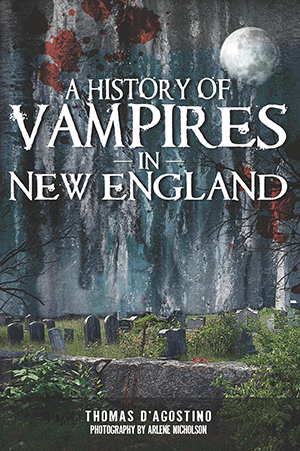
During our last trip I came across the paperback A
HISTORY OF VAMPIRES IN NEW ENGLAND by Thomas D’Agustino. How could I resist.
It seems that during the 1700 and 1800’s consumption,
the wasting disease (tuberculous), was a pandemic in rural New England. Members of whole families would die within a
few years of each other. Each person contracting the disease became emaciated,
pale, bled from the mouth and eventually died. There was no cure. Doctors did not understand the disease and religious
leaders often saw it as demonic. Many
rural families steeped in superstition believed that a vampire or undead spirit
was returning to feed on family members in order to remain alive in the
grave.
There are records of over forty graves being disinterred
throughout New England and the corps being violated in order to protect those
left alive. There were probably many
more, as family members were often buried on family farms and records not kept.
I finished the book last night, and this morning typed
New England Vampires into YouTube and
up came a lecture given by Thomas D’Agustino – the book author.
I am including D’Agustino’s lecture on the blog, but
also placing a link to the lecture so viewers can watch it full screen if they
so choose. It is interesting.
At the time of the witch mania in Western Europe,
vampire panic was gripping Eastern Europe and Russia. I wrote a monologue on The Sussex Vampire for a Sherlock Holmes scion
society of the Bake Street Irregulars.
If I can find it, I will post it later.
It is
understandable if a person wants to identify themself by their belief in a religion,
a church, a political party, an ethnicity…; but it absolutely makes no sense
that you would feel the need to identify yourself by what you do not believe.
I do not
believe in vampires, werewolves, zombies, big foot, fairies, alien autopsies,
ghost or things that go bump in the night.
I do not
believe that the world is flat or that the sun rotes around the earth.
I do not
believe that dinosaurs and humans existed at the same time
I do not
believe that a snake whispered to a woman who ate an apple which brought sin
into the world.
I do not
believe that a six-hundred-year-old man and his hundred-year-old sons built a
boat and sailed on a flood that mixed salt water and fresh water, carrying two
of every animal on earth, and that upon landing a kangaroo hopped twelve
thousand miles across three continents to go home to Australia.
I do not
believe that a child was born to a virgin.
I do not believe that statues bleed.
I do not
believe in devils and demons and angles and gods, or in a physical heaven or
hell.
I do not
believe a man god walked on water, or that a brutal human sacrifice was
performed to ‘take away the sins of the world.’
The name Atheist is a religious term that
supposes the legitimizing of religious beliefs and proposes to delegitimize anyone
that doesn’t accept the fairy tale.
If you feel
the need to attach a name to me to identify what I don’t believe in, me you
might just call me sane – I can live
with that.
Charlaine
Harris has a new series, MIDNIGHT TEXAS, and it's beginning July 24.
I have read
the three books of the series she has written so far: Midnight
Crossing, Day Shift and Night Shift; and
if this new series is as well produced as
True Blood it will be a grabber.
The main
difference between the books and the trailer is the script writers seemed to have
modified the cast.
In the book
the population of Midnight is approximately twelve: an ancient vampire, a
witch, a pawn shop owner, a psychic, a couple of weretigers, two gay angels, a mob
hit woman and some people you are not sure of.
Almost everyone in Midnight is middle aged.
But who
wants to look at a bunch of middle aged people?
In the trailer it looks like everyone is young and hot, and they changed
the two gay angels to one angle hunk – probably straight (why?)
Oh well,
that what you get when you read the books before seeing the movie.
Anyway, I
will be watching and I invite you to watch with me.
the Ol’Buzzard
Note: on YOUTUBE it looks like the series was possibly released sometime in 2016 – unless that was an advanced trailer; but it is airing here in Maine on NBC on 24 July.
Casey was
not afraid of ghost. But, every night
when she walked home she had to pass the City Cemetery and the thought of all
those hundreds of putrefying bodies buried just a few feet away creeped her
out.
Can a child
die from fright, from his own…imagination?
‘Johnny,
there is no monster under the bed. I
just looked.’
‘Yes, but
Dad, he isn’t there until you leave!’
Molly is
blind. Her parents don’t believe her
when she says that for the past two nights there has been tapping at her window
and a voice whispers ‘Please let me in.’
Her mom says it is just wind and
rain; but Molly doesn’t think so.
Tonight she will leave the window open.
How hungry
do you have to be to eat the flesh of another human being? Some might call it cannibalism, but I call it
survival.
I knew
grandma was dead when I opened the front door, but I still called her name as I
climbed the stairs. Outside her bedroom
door I hesitated; I put my hand on the knob, but couldn’t turn it: that smell
Three days till Halloween the Ol'Buzzard use it you want. You are welcome.O'B
I have asked
the question before, why is it that vampire hunters always arrive at the crypt
just as the sun is going down and no one says, ‘I’ve got an idea. Why don’t we go home and have garlic soup and
try this again tomorrow morning?’
Another
question is brandishing the cross: what if the vampire is Jewish?
A montage of
vampires just for you.
My favorite
vampire book is Salem’s Lot, but the movie sucked.
Vampires only come out at night (the same with werewolves) and vampires have to be invited in. A cross seems to work for protection from a vampire, unless it happens to be Jewish (or Muslim or Hindu...,) and silver will will repel werewolves. In both cases just stay in your home and don't go into the woods at night on a full moon. BUT ZOMBIES CAN WALK UNDER WATER SO THERE IS NO PLACE TO HIDE!
I am some disappointed. Here it is the day before Halloween and after
searching the online TV guide for Halloween movies I came up with nothing
except a Michael Myers marathon – and that sux.
As I have
stated on other blogs I don’t believe in ghost and goblins and things that go
bump in the night; but I love Halloween and movies of monsters and witches and things
that represent this season.
Actually, my
wife and I celebrate Halloween.
Halloween for us evolved from the times of witchcraft: maidens, mothers
and crones – a time when wise women practiced medicine with herbs and spells
and offered hope to people in special need.
Witches, if
you will, were uniquely in touch with the cycles of nature, as only women can
be. Men and religions over the centuries
have suppressed these connections, until today girls and women and crones do
not even realize the power they possess – they do not celebrate their
nature.
Halloween is
their time, a time of witches, a time of women – It is the quintessential
holiday for women. A time for women to
celebrate all stages of their life and renew their connections with Mother
Nature.
Yellow Dog
Granny tells a GHOST STORY on her blog.
(check out the link above)
I can’t remember the number of people that I actually respect that have
told me ghost stories; but over seven decades it has been quite a few.
I don’t
believe in ghost and goblins and things that go bump in the night. I do believe that there is a small veil
between the conscious and the unconscious – the same unconscious that gives us
dreams.
Here is my
reasoning:
I don’t
believe that mankind is somehow divine among the animal kingdom. That there is actually a god in our image
and that after death we continue on. If
that were true then evolution would be untrue.
I place
ghost in the same category as vampires and werewolves. As
long as we are truly safe we love to be scared – no one really wants to live
through a zombie apocalypse, but we love to watch it on TV.
A friend of
mine, that I respect, says he saw the specter of a Civil War soldier while
renovating an old vacant home in rural Maine.
He said the specter was dressed in a Confederate uniform; a woman I know
claims to have seen a lady in a white nightgown at a supposed haunted bed and
breakfast; numerous people claim to have seen a Confederate officer on a white
horse at night in the Battleground Cemetery in Vicksburg, Mississippi. The list could go on and on.
One of my
rational objections is the clothes. People
are born without clothes. Clothing is strictly
a social amenity. Why would dead people come back clothed? Is there a ghost wardrobe available after
you die? Can you check out a ghost horse
and saddle and bridal and sword along with your uniform before you decide to reappear? Or, do your clothes die with you and come
back as ghost in their own right?
How come the
Confederate officer can have his ghost horse and yet the two cats that I loved
and lost won’t come back and stay with me?
Are there ghost
birds and eagles and bats, or are humans somehow special. At what point in the evolutionary
development of mankind does this ghost ability evolve: Australopithecus –
Robust – Heidelbergensis - Neanderthal?
At what point does man become divine?
When we are
in our fight or flight mode is our mind capable of playing tricks on us? I think so.
But, it doesn’t make it any less spooky.
Charlaine Harris
has started a new series. West of Bon
Temps, Louisiana, in the west Texas town of Midnight – population 10 – the story
continues.
In the first
of the series, Midnight Crossroad, we meet the cast of characters – a strange
group that choose to live in the middle of nowhere to protect their
privacy. It is a murder mystery with a
strange cast that leaves you wondering.
In the
second book, published this year, you find out more about the residents.
Midnight is
a spot in the road in the middle of west Texas nowhere. If you ever travel through you might have the
urge to stop and gas up and use the restroom at the convenience store; but you
would be advised to travel on through; unless you are unafraid of vampires,
weretigers and witches with talking cats.
Why is it
that in all the vampire stories the vampire hunters always arrive at the crypt just
as the sun is going down; and no one ever says, ‘It’s getting dark. I've got an
idea: let’s come back tomorrow morning?’
Bram
Stoker’s Dracula, published in
1897, is, without question, the most famous horror novel ever written. The book is a compilation of letters and
journal entries that sets the stage for all vampire fiction to come.
Francis Ford
Coppola’s motion picture version of Dracula
follows the plot as closely as any movie can in condensing a book to a two hour
movie script.
But, to
receive the full breadth and depth of the story you should place Dracula on your reading list,
preferably to be read just before bed.
If you find
yourself hooked on the book Dracula you should follow it with Dracula’s Heir by Sam Stall.
“In 1897 Archibald Constable & Co.
published Bram Stoker’s Dracula… For some reason still debated by scholars, the
first chapter of Dracula was cut from the book just weeks before
publication. Here it becomes the
central clue in a spinetingling original interactive mystery.”
Excerpt from Amazon.com.
And then
there is Stephen King’s Salem’s Lot:
the scariest vampire book ever written and the worst vampire movie ever
made.
Salem's Lot should be read alone on a
dark and stormy night.
In 1985 my
wife and I moved into a rundown 1832 farmhouse situated alone, in the woods, at
the end of a one mile long dirt road in rural Maine. The
house had no electricity, plumbing or running water. At night, in bed, by lamp light my wife would
read aloud a chapter from Salem’s Lot.
It was scary as hell then, and I have read it since – and it is still
scary.
I do not believe in gods, devils, angels, ghost, gnomes, fairies, ogres, zombies, vampires, werewolves, and things that go bump in the night. However, I do like the macabre, and enjoy reading (and viewing) horror stories.
During the 1980’s my wife and I moved into an isolated, one hundred- fifty year old farm house, one mile off the main road in the middle of the Maine wilderness. The house had no neighbors, no electricity and no running water; and at night, in bed, by lamp light, my wife would read aloud a chapter from Stephen King’s Salem’s Lot. It was scary as hell.
I am a member at large of The Occupants of the Empty House - a scion society of the Baker Street Irregulars - which hold their meetings in Du Quoin, Illinois. We are a group dedicated to the study of the chronicles of Dr. John Watson and Sherlock Holmes.
One of the Sherlock Holmes monographs I published in the Beeman’s Christmas Annual was an insight to “THE ADVENTURE OF THE SUSSEX VAMPIRE; and I offer it here as a comment of interest at the kick-off of the new season of True Blood on HBO.
BRITIAN AND VAMPIRISM IN THE NINETEENTH CENTURY: as related to “THE ADVENTURE OF THE SUSSEX VAMPIRE.”
But first, on earth as Vampire sent,
Thy corpse shall from its tomb be rent:
Then ghastly haunt thy native place,
And suck the blood of all thy race;
There from thy daughter, sister, wife,
At midnight drain the stream of life;
Yet loathe the banquet which perforce
Must feed thy livid living corpse.
Thy victims are they not yet expire
Shall know the demon for their sire,
As cursing thee, thou cursing them,
Thy flowers withered on the stem
From: The Gaiour,” by Lord Byron
Baring-Gould sets the date for “The Adventure of the Sussex Vampire” as taking place between Thursday, November 19, to Saturday, November 21, 1896.
Holmes: “The idea of a vampire was to me absurd. Such things do not happen in criminal practice in England.”
Between 1600 and 1800 while Britain and Western Europe were in the throws of witch mania, Eastern Europe was experiencing vampire frenzy. In the East, even government officials frequently were involved in the hunting and staking of vampires. Westerners never seriously considered the existence of vampires until the mid eighteenth century when there was an outbreak of alleged vampire attacks in East Prussia (1721), and Austro-Hungary (1725).
Two famous cases involved Peter Plogojowitz and Arnold Palole.
Plogojowitz
Plogojowitz died at the age of 62, but returned to raise havoc among his family and neighbors, many who died from loss of blood. According to records, Plogojowitz’s grave was opened and his body was found to be fresh.
Arnold Paole
Arnold Paole was an ex-soldier who claimed to have experienced a vampire attack while serving in Greece. Upon returning home he died from a fall while working on his farm. Within two months after Paole’s burial there were attacks attributed to him. All of the victims died shortly after. Two military officers, two army surgeons and a priest exhumed Arnold Paole’s body; and the corpse was found to be fresh. Over the next five years there were a number of inexplicable deaths. A mass exhumation was carried out in 1732 and eleven corpses were found to display the same trait as Paole – no decomposition.
Both of these cases were well documented by government officials who examined the facts and the bodies. These two cases created an epidemic of alleged vampire attacks in rural villages; resulting in a score of bodies being exhumed. Eventually the Austrian Empress Marie Theresa sent her personal physician to investigate. He reported back to her that vampires did not exist. The Empress passed laws prohibiting the opening of graves and the desecration of bodies, bringing an end to the vampire frenzy in Austria. (Vampires in Myth and History, by Beverley Richardson.)
One reason for the dichotomy of folklore between Western and Eastern Europe can be attributed to the split that took place in 1054 between the Orthodox Church in the East, and the Roman Catholic Church in the West. This difference can be linked to centralizing the vampire myth to Eastern Europe. The belief of the Catholic Church was that the bodies of saints would not decay in the grave; while the Orthodox Church believed that undecayed corpses were a sign of evil and a link to Satan.
In 1486 the Catholic Church had published The Malleus Maleficarium as a handbook for the discovery and eradication of witches. It also covered vampires and how they should be dealt with. By 1600 this treatise was being used as a “bible” by witch and vampire hinters across Europe. (Christianity and Vampirism, by Angie McKaig.)
Holmes: “Make a long arm Watson and see what V has to say.” I leaned back and took down the great volume to which he referred…”Hello! Good old index. You can’t beat it. Listen to this, Watson: Vampirism in Hungary and again in Transylvania.”
Vampire myths go back thousands of years and occur in almost every culture. The Vampire folklore spread out along the Black Sea Coast to Greece, the Balkans and the Carpathian Mountains, including Hungary and Transylvania. The Slavic people from Russia to Bulgaria and Serbia to Poland also had rich vampire folklore. (B. Richardson.)
He turned over the pages with eagerness, but after perusal he threw down the great book with a snarl of disappointment. “Rubbish, Watson, rubbish! What have we to do with walking corpses who can only be held in their graves by stakes driven through their hearts? It’s pure lunacy.”
The vampires of folklore of the seventeenth and eighteenth centuries have only basic similarities to the vampire fiction of today. The vampires then did not fly, or wear capes, or change into bats. A man who was contaminated died; then returned to feed on the blood of his family and neighbors. After a while (anywhere from a few days to a few years, depending on the country of the occurrence) he became more humanlike and was indistinguishable from living humans. He was able to remain out in the daylight and eat normal food. At this time he would move to another village and often get married and have children, reverting to his blood lust only on weekends or certain saint’s days. (The Socially Sophisticated Undead in Folklore, by Patrick Johnson.)
Considering the original vampire legends, the actions of Delores Ferguson in The Adventure of the Sussex Vampire could well have been interpreted as vampirism.
Though vampire fiction became popular in the eighteen hundreds in Britain, the stereotype of today’s vampire fiction had not yet embedded. In 1813 the vampire appeared in Britain in Lord Byron’s poem “The Giaour.” In 1819 John Polidori wrote The Vampyre on a challenge from Lord Byron (Mary Shelley wrote Frankenstein at the same time/challenge.) And, In 1848 Varney the Vampyre begin serialization as a penny dreadful. If we accept Baring-Gould’s date of the Sussex incident as 1896, Holmes was conducting his investigation one year before Bram Stoker introduced Dracula, and set the pattern for vampire fiction as we know it today.
Accounts of vampirism in the rural areas of Eastern Europe were not unheard of even in Sherlock Holmes’s time. In The Twelve Years Study of the Eastern Question in Bulgaria by S.B.G. St. Clair and Charles A. Brophy (London: Chaman and Hall Press;, 1877) the authors account an episode that alleged to have taken place in the 1840’a in the Bulgarian village in which they were presently living. The locals told them that a man had arrived in the village and established himself as a tradesman. He married a local girl, but his new wife complained that he was out every night until dawn. Cattle and horses became sick and died and it was noted that blood had been drained out of them. The village suspected the man of being a vampire and when they examined him they found he had only one nostril – a sure sign that he was a vampire. The villagers bound him, took him to a hill outside the village, and burned him alive. Surely with Holmes’s penchant for the unusual he had knowledge of this and other incidents.
Watson: “A living person might have the habit. I have read, of example, of the old sucking the blood of the young in order to retain their youth.”
“You are right, Watson. It mentions the legend in one of these references. But are we to give serious attention to such things?”
This reference is obviously of Elizabeth Bathory who was born a noblewoman to a powerful family in Transylvania in 1560. Elizabeth was married as a teenager, but lived with a constant fear of aging. Her husband died in 1604 and she moved to Vienna. Countess Elizabeth became convinced that the blood of young girls was the secret to eternal youth and beauty. She is believed to have murdered more than six hundred young women in order to have blood to drink and bathe in. In December of 1610 she was put on trial for her crimes, but being a noblewoman she was not allowed by law to be sentenced to death. She was sentenced to life imprisonment in her castle in Cachtice, where she died in August 1614. (Who is …Elizabeth Bathory? By Angie McKaig.)
Holmes constantly reminds us that it is a capital mistake to theorize in advance of the facts (SCAN, SECO, STUD) – yet in the case of the Sussex Vampire he does exactly that. Before leaving Baker Street he has decided the outcome of the case, and he commences to pursue his investigation to secure facts to support his theory. Considering the extensive vampire folklore of Eastern Europe that goes back for centuries, why is Holmes so adamant and closed-minded in considering the possibility of the existence of vampires? Is this an indication of some prior experience with the preternatural, supernatural, and things that go bump in her night? This is the real mystery in “The Adventure of the Sussex Vampire.”
The way I see it, being dead is not terribly far from being on a curise ship. Most of your time is spent lying on your back, the brain has shut down, the flesh begins to soften, nothing much new happens, and nothing is expected of you.